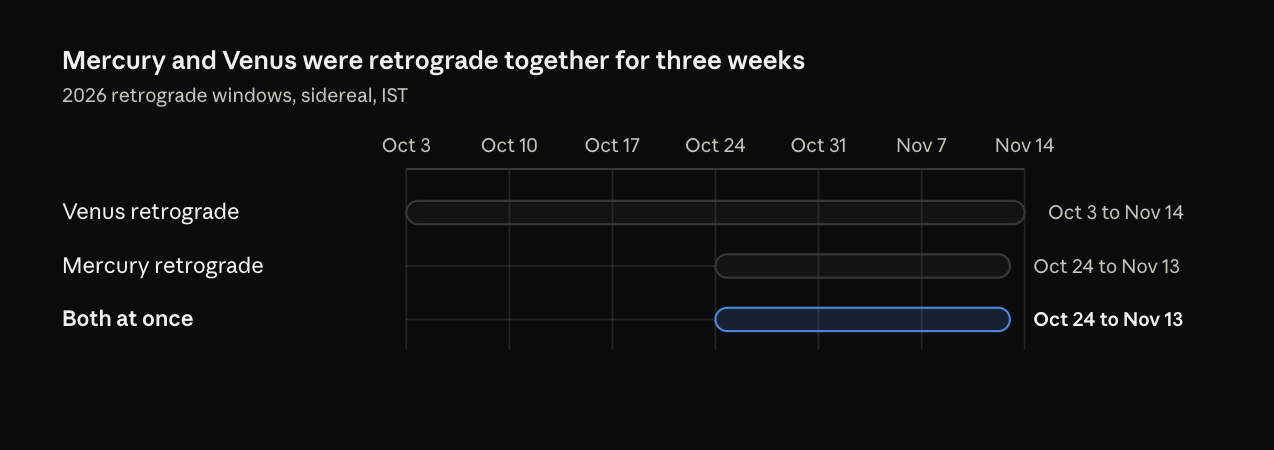
On the night of 13 November 2026, Mercury turns direct. A few hours later, around 6 AM on 14 November, Venus does the same. Mercury has been retrograde since 24 October, and Venus since 3 October. For three weeks, both were retrograde.
If you’ve spent any time online this autumn, you’ve probably been warned: don’t text your ex, don’t sign anything, back up your phone, and brace for chaos. Most of that comes from a misunderstanding of what retrograde actually is.
So let’s start there. What is really happening in the sky, what Vedic astrology says about it, and why the end of these two retrogrades is a moment of clarity, not a crisis. (All positions here use the sidereal zodiac, the system Vedic astrology uses, with times in IST.)
What you’re actually seeing
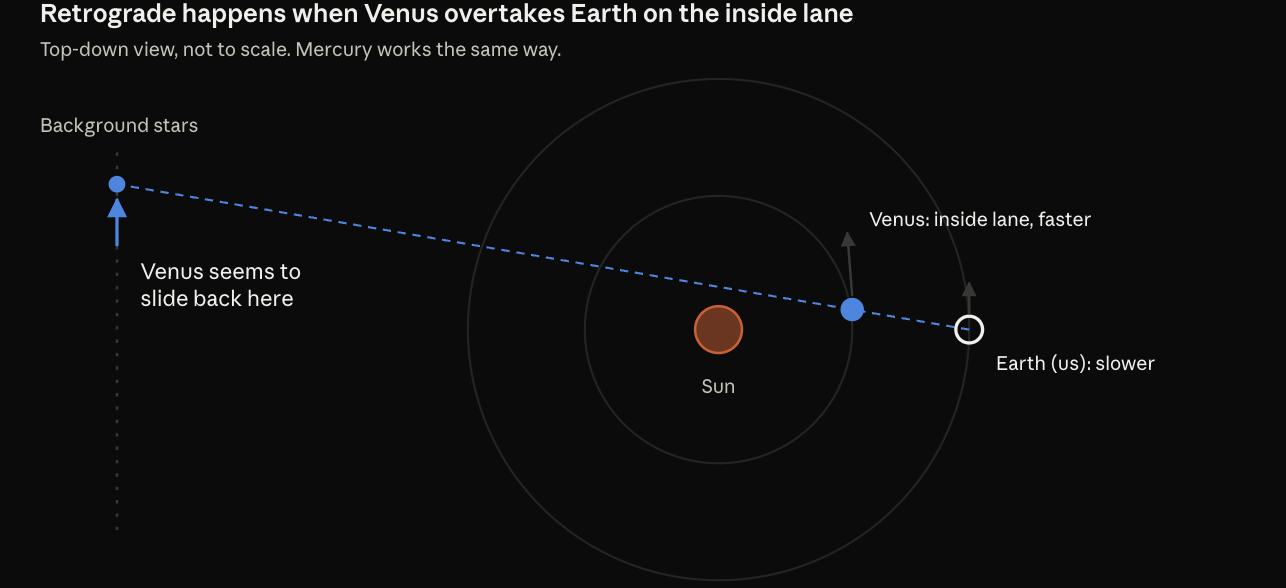
No planet has ever moved backward. Not once. Every planet circles the Sun in the same direction all the time. Retrograde is about where we stand when we look.
Mercury and Venus orbit inside Earth’s path, closer to the Sun, and they move faster than we do. Every so often, one of them swings past us on the inside lane, passing between Earth and the Sun. From our moving point of view, it seems to drift the wrong way against the distant stars for a few weeks. Then it pulls ahead, and the illusion ends.
The loop in the sky
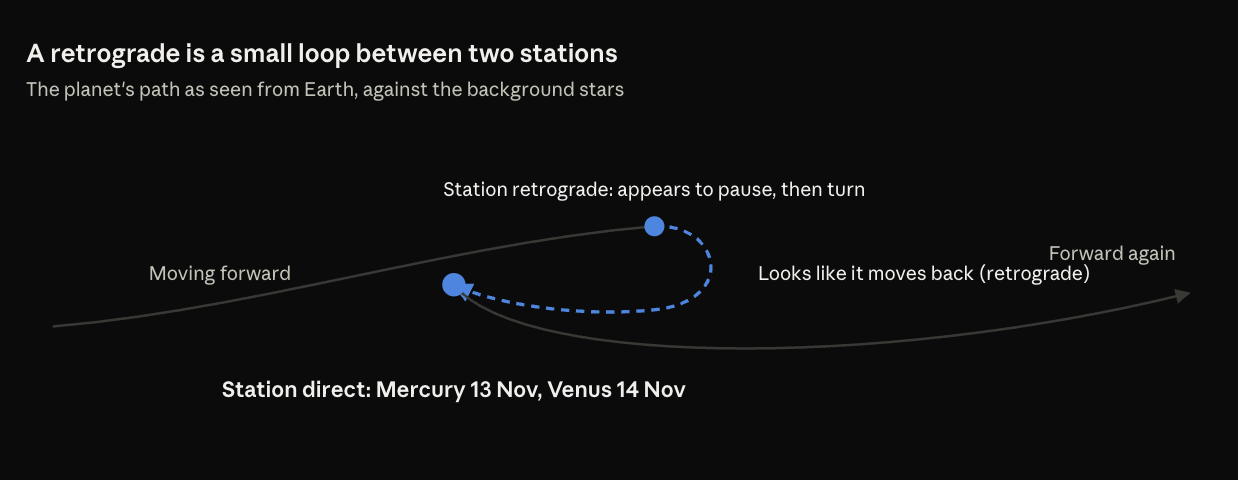
If you plotted Mercury’s position against the stars every night for two months, you wouldn’t see a straight line. You’d see a small loop. The planet slows, seems to stop, drifts back, stops again, and carries on.
Those two stopping points have a name: stations. The first is when the planet “stations retrograde.” The second, the one happening on 13 and 14 November, is when it “stations direct” and starts moving forward again.
How Vedic astrology reads a retrograde planet
In Vedic astrology, a retrograde planet is called “vakri,” which means twisted or ambiguous. It simply means a Vakri planet acquires different and distinct characteristics. Retrograde Mercury gives a unique style of communication that can clearly be distinguished from others. In a birth chart, a Vakri planet suggests that the areas of life it rules are experienced deeply and internally. Retrograde planets often point to past life lessons, unfinished business, or a unique, non-traditional way of looking at the world. Retrograde planets force us to learn lessons from past mistakes and make changes in our behavior. Vakri planets are also responsible for creating uncertainty in a person’s life. Dasha of the Vakri planets has special significance, as it has the potential to completely transform thinking, aspirations, and overall outlook of life. It can bring major transformations in career, relationships, and social circumstances.
In fact, classical texts give a retrograde planet high cheshta bala, or strength from motion. A planet near its loop is closest to Earth and at its brightest. So the traditional reading is not “weak and broken,” but “strong and turned inward.” Retrograde planets also reflect obsessive behavior or strong willpower to achieve goals related to various aspects of that planet. Retrograde Venus can show obsessive, twisted love affairs.
That is why the old advice around retrogrades is about reviewing, not avoiding. Re-read. Revisit. Finish what is half done.
Mercury retrograde: the planet of words, looking back
Mercury (Budh) rules how you think, speak, learn, write, and trade. It goes retrograde about three times a year, for roughly three weeks each time. This round ran from 24 October to 13th November in Libra.
What that tends to feel like:
- Conversations you thought were finished come back for a second round. Documentation of agreements in business, ownership papers, identity cards, etc., will require revisiting and correction.
- Planning and logical problem solving often become unconventional, as the situation itself demands it.
- You notice what you meant to say after you’ve said something else. Communication breakdowns like misunderstandings, missed emails, conflicting schedules, and friction in conversations.
- Technology and travel glitches like device malfunctions and delayed trains and flights.
- Reconnecting with old friends, neighbors, and family members.
- Self-reflection, introspection, and finishing incomplete tasks and issues.
- Retrograde enhances great problem-solving skills, creativity, and critical thinking.
None of this means communication breaks down. It means it gets a second draft. When Mercury turns direct, the second draft is usually the clearer one.
Venus retrograde: the planet of love, looking back
Venus (Shukra) rules love, attraction, beauty, comfort, and what you value, including money. It turns retrograde far less often than Mercury: about once every 18 months, for around six weeks. This round began on 3 October in Libra and ends on 14 November in Virgo.
What that tends to feel like:
- Old feelings, or old people, cross your mind more than usual. Unresolved romantic issues resurface. It is time for high emotional sensitivity.
- You question what you really want from a relationship, a purchase, or your own style. Major change is in physical appearance, like a drastic haircut or tattoos.
- Things that felt fine start to feel off, and things you overlooked start to look good.
- Impulsive financial choices, speculative investments, and purchasing expensive luxury products or gadgets.
- Artistic projects, style choices, and designs of products may undergo major changes during this time.
This isn’t a sign your ex is coming back. It is Venus asking whether your choices still match your values. When it turns direct, those answers tend to settle.
Why the ending matters more than the start
The headlines focus on when a retrograde begins. The quieter, more useful moment is when it ends.
Around a station, a planet barely moves. For a few days it sits almost still in one spot, so its themes feel concentrated, like a song stuck on one line. After it turns direct, it picks up speed slowly. That’s why the week after 14 November is less about a switch flipping and more about things gradually unknotting.
This year, both planets reach that turning point within about nine hours of each other. Mercury goes retrograde three times a year, and Venus does about once every 18 months, so having them overlap for three weeks and end together is uncommon.
How to use the week after
You don’t need to do anything special. But if you want to work with the moment rather than worry about it, a few honest questions help:
- What did I revisit in the last six weeks? A person, a plan, an old habit. Notice what came back without being invited.
- What did I learn the second time?The review is the point. Write one line about what you see now that you didn’t before.
- What’s ready to move forward? Pick one thing you have already thought through and take one small step on it.
- What can I let rest? Not everything that resurfaced needs action. Some things came back only so you could close them.
And yes, if you were waiting to sign something, send something, or decide something, you can. Just decide on the facts in front of you, not on the calendar.
Frequently asked questions
What does “retrograde” mean in simple words?
A planet looks like it is moving backward because of where Earth is and how fast it is moving. No planet actually reverses.
When does Mercury retrograde end in November 2026?
Mercury turns direct on 13 November 2026, at about 9:23 PM IST, in sidereal Libra.
When does Venus retrograde end in 2026?
Venus turns direct on 14 November 2026, at about 6 AM IST, in sidereal Virgo.
Is a retrograde planet bad in Vedic astrology?
No. Classical Vedic astrology gives a retrograde (vakri) planet strong motivational strength. Its themes turn toward review rather than new starts.
How often do Mercury and Venus go retrograde?
Mercury about three times a year, for around three weeks each time. Venus is about once every 18 months, for around six weeks.
Why do some websites say these retrogrades are in Scorpio?
Western astrology uses the tropical zodiac, which sits about one sign ahead of the sidereal zodiac used in Vedic astrology. The dates line up closely; the sign names differ.
Does a retrograde affect everyone the same way?
No. It depends on which houses Libra and Virgo occupy in your own birth chart.